
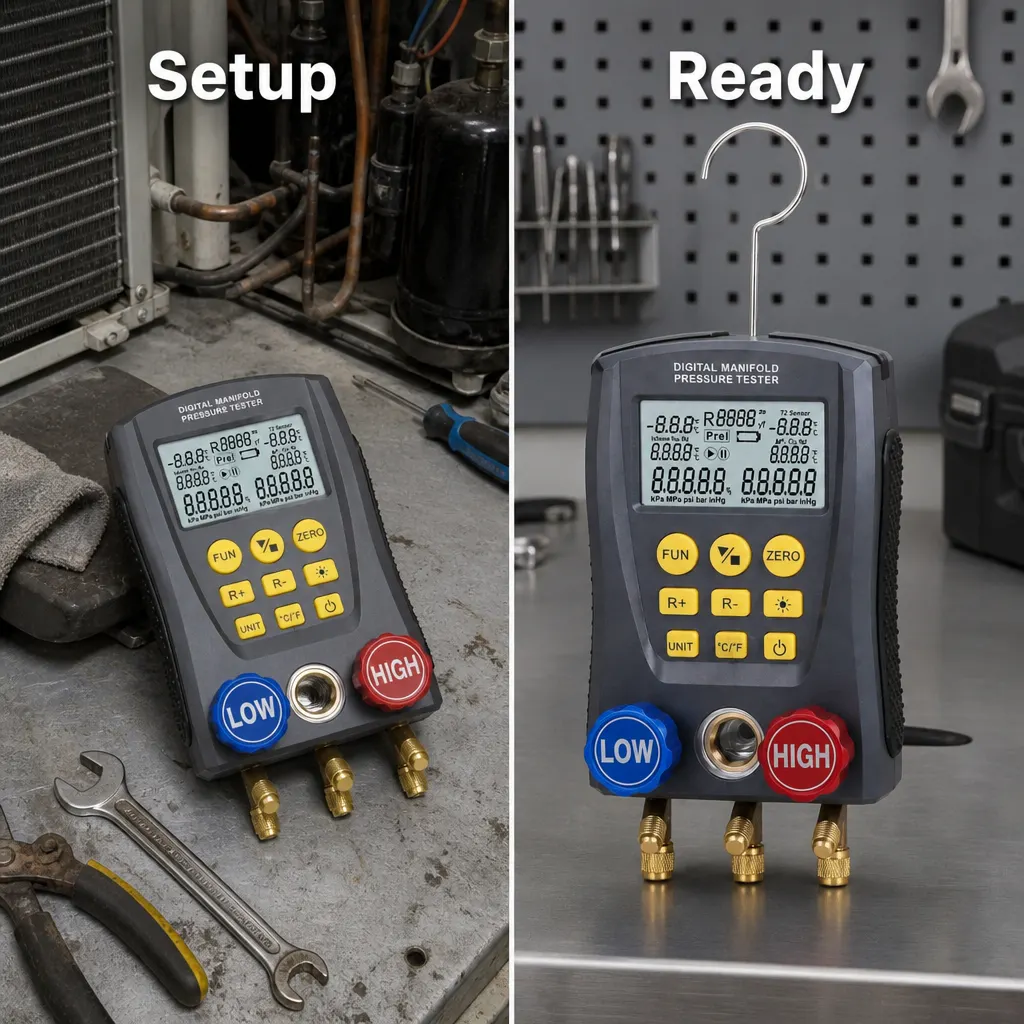
Short answer: A digital pressure gauge with a leak test timer is useful only when its verified pressure capability and connections match a defined test procedure. The Holdleak product page identifies the MZ517 kit version as a digital vacuum and pressure manifold tester and describes a timed hold comparison. It does not publish pressure range, accuracy, units, fitting sizes, included hoses, regulator capability, temperature compensation or a pass threshold. Buyers should obtain those facts before ordering. The timer supports record-keeping; it does not locate a leak, select a safe pressure or decide whether an HVAC circuit passes.
Compare evidence before display features
A clear digital display and integrated timer may reduce separate notes, photographs or phone timing, but those conveniences matter only after the instrument is technically suitable. The current page confirms the MZ517 kit version and digital vacuum or pressure manifold family. It excludes the simplified MZ517 SKU.
The manufacturer does not specify range, accuracy, resolution, supported units, overload protection, environmental rating, calibration status, fitting sizes or kit contents. Each is a procurement question for a pressure instrument. A photograph or shared model number cannot close the gap.
| Buying criterion | Why it matters | Current evidence |
|---|---|---|
| Pressure range and rating | Must cover the approved test safely | Manufacturer does not specify |
| Accuracy and resolution | Affects the usefulness of recorded changes | Manufacturer does not specify |
| Fittings and kit contents | Determine connection to existing equipment | Manufacturer does not specify |
| Hold or leak timer | Keeps elapsed time with the comparison | Described on the product page |
Define what the timer can prove
The timer can document how long the observation ran when the workflow is used correctly. It does not establish the correct duration, allowable pressure movement or reason for a change. The manufacturer does not specify automatic temperature compensation or a leak criterion for the MZ517.
Use the exact equipment manufacturer's commissioning or service instructions to define the test. Record the information required by that procedure, including relevant conditions, and treat an unexplained change as a reason for competent investigation rather than as automatic proof of one leaking joint.
- Obtain the exact HVAC or refrigeration system test instruction.
- Verify the gauge specifications and connection ratings against that instruction.
- Define which readings and conditions must enter the service record.
- Use only the documented acceptance rule for the named system.
Apply pressure-test and PPE controls
HSE GS4 addresses pressure-test planning because failure can release stored energy and fragments or fluid. The responsible person should control access, equipment condition, pressure limitation and foreseeable failure before anyone relies on a gauge reading. Do not stand in line with connections or improvise adapters.
PPE should follow the risk assessment and cannot replace separation or pressure controls. HSE guidance identifies hazards including gas, chemical or metal splash and spray from pressure leaks. Select eye, face, hand and body protection for the actual gas, hot-work aftermath and test arrangement.
- Use documented, rated components throughout the pressure path.
- Provide overpressure protection required by the system and test plan.
- Control the area so a failure does not expose other people.
- Inspect, isolate and depressurise according to the approved procedure.
Know when this gauge is the wrong purchase
The MZ517 is a poor fit if the need is a nitrogen-cylinder regulator, vacuum pump, refrigerant charging station or physical leak locator. None of those functions is established by the product page. It is also unsuitable when fitting compatibility or operating limits remain undocumented.
If the work touches equipment containing F gas, the applicable GOV.UK qualification and company-certification rules must be checked. A facilities owner can use the article to question a contractor's records, but should not interpret the timer as permission to open or service a refrigerant circuit.
Related guides and product details
The MZ517 timer may tidy pressure-hold records, but the purchase is defensible only after range, accuracy, connections and contents are verified. Keep pressure limits, acceptance and refrigerant work with the exact manufacturer procedure and qualified personnel. Read HVAC Nitrogen Hold Test Gauge UK: Safety Checklist for related guidance. Read Digital Manifold Gauge for a Nitrogen Pressure Test for related guidance. Review the documented specification on the Digital pressure gauge with hold/leak timer for post-braze nitrogen verify product page before ordering.
Sources and safety context
- Supports the MZ517 kit identity, excluded simplified SKU and timed hold workflow. Current Holdleak product page.
- Supports pressure-test risk planning and control of foreseeable failure. HSE: Safety requirements for pressure testing.
- Supports task-specific PPE selection for gas, splash and pressure-leak hazards. HSE: Using the right type of PPE.
- Supports using system-specific maximum pressure and leak-test instructions. Daikin R32 split-series installation manual.
- Supports the legal competence boundary for work on F-gas equipment. GOV.UK: Qualifications required to work on equipment containing F gas.